· Morgan Reyes
How Tall Should a Dog Gate Be? Heights by Breed Size and Jumping Ability
People asking how tall a dog gate should be usually have one dog in mind — the one that just cleared the back of the sofa, or the puppy whose legs lengthen weekly. Height is the easiest gate number to compare and the easiest to overrate: dogs get past gates four ways, and height answers only one. This guide goes size by size, then covers the three numbers that decide more than inches do.
Tall enough for a dog is a different question than tall enough for a toddler
The toddler rule is about climbing: a child scales a gate rung by rung, so the guidance for children is written around the child's height and the gate's footholds. The version for staircases lives on our baby gate for stairs page; this guide will not restate it. A dog does not climb rung by rung. It has four routes past a barrier: over it, by jumping or scrambling; through it, when bars leave a gap for a muzzle or a shoulder; under it, when a paw finds daylight at the floor; and straight through it, by leaning its weight into the panel until the mounting gives.
Height closes only the first route, and even there it is one of three things that decide whether a dog goes over — whether it physically can, whether it can see a reason to, and whether it has ever been rewarded for trying. The panel height settles the first for most dogs. Placement and the household settle the other two, and those come further down.
Small dogs: the gate is a wall, the floor is the question
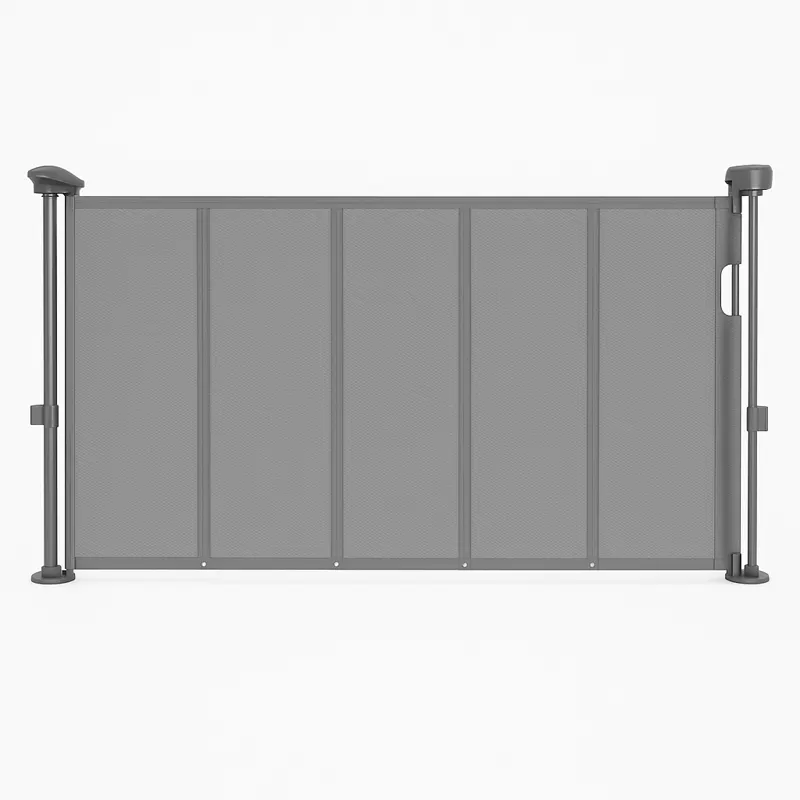
For a small dog — the size you carry up the stairs under one arm — a 34-inch (86cm) panel is not a jump it will consider. Small dogs test a gate at the bottom and the sides, not the top: a nose worked under the frame, a shoulder pushed into the spacing between bars, a paw hooked through a gap sized for a toddler, not a terrier. Every SnugGate size is built with a minimal bottom gap by design, and the woven mesh has no bar spacing at all, which removes both routes in one piece of fabric.
What remains for a small dog is pushing — not at the frame, which a light dog does not shift, but into the lowest part of the mesh, where the panel meets the floor base plate. That is the point of the 4 fiberglass rods running through the panel: they keep the mesh taut at the bottom edge instead of letting it belly outward and open a corner. For a small dog, then, the height is settled before you order; the number to check is the width, so the gate fills the opening edge to edge — the sizing notes on our pet gate page cover that.
Medium dogs: they climb far more often than they jump
Medium dogs — knee-height, the spaniel-to-collie range — are the ones that turn up on the wrong side of a gate they "could not possibly" have cleared. Watch one do it and it is rarely a jump but a climb: hind feet on a horizontal rail, front paws over the top bar, and a scramble. A bar-style gate hands a medium dog a ladder, and the bracing that keeps a rigid frame square is exactly the rung it uses. Our material comparison goes through why the bars, not the metal, are the opening.
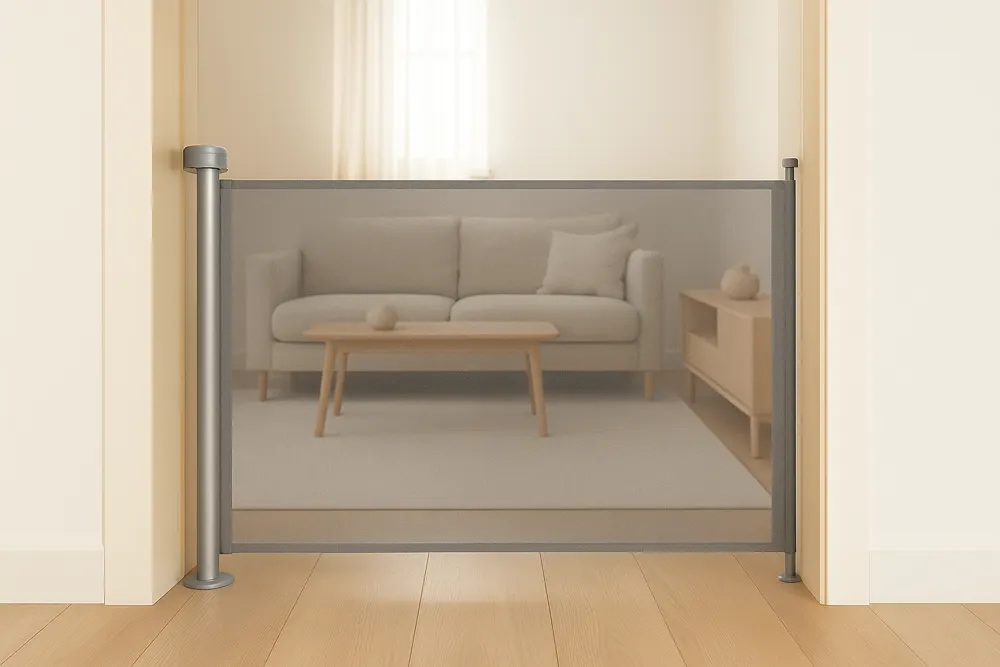
A taut mesh panel gives that climb nothing to start from: no rail for a hind foot, no bar to grip, and a top edge with nothing below it to push off from, so a dog standing on its hind legs has nowhere to start the climb. It is the same anti-climb logic our extra wide gate guide lays out for toddlers on a wide span — the mechanism is identical, only the climber changes. For a medium dog, 34 inches with nothing to climb does more than a taller gate with rungs.
Large and athletic dogs: what the numbers say, and what they leave out
This is the size that drives the question, so here is a checkable figure. The American Kennel Club's agility regulations set jump heights by the dog's height at the withers: dogs 11 inches and under jump 8 inches, dogs 14 and under jump 12, dogs 18 and under jump 16, dogs 22 and under jump 20, and the top Regular division — dogs over 22 inches at the withers — jumps 24 inches. SnugGate's panel stands 34 inches, ten inches above the highest division a large dog competes in, and at the top end of the 29 to 36 inch range typical bar-style gates fall in.
Read the figure for what it is. Competition heights are set for trained dogs jumping at speed off a run-up, with the dog's joints in mind, so they describe what a fit large dog is routinely asked to do, not the most it can do. A tall, athletic dog that has decided the far side is where it needs to be can clear more than 24 inches. What separates the large dog that never tries from the one that does is almost never an inch of panel: it is the run-up, the reason, and the reward.
Those three are yours to control. A gate across a hallway doorway gives no run-up: the dog arrives at a walk, and looking through a see-through mesh panel — it can watch you and the room beyond — takes away much of the reason. Then the reward: a large dog that has gone over once and been greeted, fed or let out has learned a lesson no panel unteaches, so supervise the first weeks. As our dog gate for stairs guide puts it: with a serious jumper, the gate manages the space and training manages the dog.
Highest Regular-class jump height in AKC agility — the division for dogs over 22 inches at the withers. SnugGate's panel stands 10 inches above it
— American Kennel Club, Regulations for Agility Trials and Agility Course Test (ACT), Chapter 2 Section 4 — Height Divisions, 2024
Puppies and senior dogs: how tall a dog gate should be changes with age
A puppy of any breed meets a 34-inch panel as a wall for months, and those months matter more than the height does. A dog that spends its first year learning that the gate simply does not open carries that belief into adulthood — the adult dogs that never test a gate are usually the ones that never had a reason to. Mesh helps here too: puppies chew, and a woven panel with 4 rods inside offers no slat edge to start on.
Older dogs jump less and need the gate for a different reason: staying off stairs they used to take two at a time. If an older dog has started refusing stairs, landing awkwardly or hesitating at a step it used to ignore, that is a conversation for your veterinarian rather than a gate question — the gate's job is to stop the unsupervised attempt while you get that answer. At the bottom of a flight, the floor hook included with SnugGate adds hold where a slow dog leaning into the panel would otherwise work it loose.
Height is one of four numbers, and the other three decide more
| Route past the gate | What the dog does | What closes it |
|---|---|---|
| Over the top | Jumps, or climbs the rails | 34-inch panel with no footholds; no run-up; supervise the first weeks |
| Through the panel | Muzzle or shoulder between bars | Woven mesh with no bar spacing |
| Under the frame | Nose or paw at the floor | Minimal bottom gap; 4 rods keep the base taut |
| Knocking it down | Leans its full weight on the panel | Telescoping poles tensioned to the frame, floor base plate, optional floor hook |
Three of the four rows have nothing to do with height, and they are the rows that catch most dogs. Tension is the one buyers under-check: any pole gate settles as a mat compresses or a frame moves, and the sign is a corner a paw can lift — the fitting sequence and the checks that confirm the gate is set are in our installation guide. Width is the fourth number: a gate an inch shy of the opening leaves a side gap no panel height compensates for, so measure at the widest point and choose the size that covers it with margin — Small to 55 inches (140cm), Medium to 71 inches (180cm), Large to 110 inches (280cm).
How tall should a dog gate be? The short version by dog size
| Dog | What it actually tries | What 34 inches does | What you add |
|---|---|---|---|
| Small (carried under one arm) | Under, through, pushing at the base | A wall — not attempted from the floor | Fill the width edge to edge; re-check tension after the first week |
| Medium (knee-height) | Climbs bar gates using the rails | A wall once there is nothing to climb | Mesh rather than bars; no furniture beside the gate to launch from |
| Large (hip-height) | Rarely tries; can clear it when motivated | Ten inches over the top AKC agility division | No run-up, see-through panel, no reward for crossing, early supervision |
| Puppy, any breed | Chews, then tests the bottom | A wall for months | Use those months to set the habit |
| Senior dog | Leans; stops jumping | Keeps unsupervised stairs off the table | Floor hook at the bottom of a flight; your vet if stairs are being refused |
For a small or medium dog the 34-inch panel is the complete answer; for a large dog it is the panel that removes the climb entirely, at a height no jumping-class figure asks a dog to clear. A cat is the one household member that treats 34 inches as a hop — our cat guide covers what the gate does in that household instead. One last variable is how often you open it: a panel that folds flat gets closed again, while one that has to be lifted out gets left open, which is the case our retractable dog gate guide makes.
Panel height on all three SnugGate sizes — the same 86cm whether the opening is 55, 71 or 110 inches wide
— SnugGate product specifications, 2026
Average rating across 16 Verified reviews, including a buyer who installed the 110-inch Large in front of a garage to keep a dog contained
— SnugGate Verified reviews, 2026
Frequently asked questions
Is a 34 inch gate tall enough for a large dog?
For most large dogs, yes: 34 inches (86cm) is ten inches above the 24-inch jump height the American Kennel Club sets for its tallest agility division, and a dog arriving at a doorway at a walk has no run-up. A large dog that has decided to go over can clear it, so the panel does its part — nothing to climb, nothing to squeeze under — and you do yours: no run-up, no reward for crossing, and supervision in the first weeks.
Can a dog jump over a mesh baby gate?
A fit large dog can, physically. Most dogs that end up over a gate did not jump it, though — they climbed it, using the rails of a bar-style gate as rungs. A taut mesh panel removes that route, which is why the same 34-inch height stops far more dogs as mesh than it does as bars.
How tall should a gate be for a puppy?
Any of the three SnugGate sizes: 34 inches is a wall for a puppy of any breed for months. Use that time — a dog that grows up never getting past the gate rarely tests it as an adult. Choose by width, and pick mesh over slats so a teething puppy has no edge to start chewing.
Does a bigger dog need a taller gate than a small one?
A small dog goes under or through, a medium dog climbs, and only a large dog considers the top edge — so the number that matters changes with size: bottom gap for small dogs, footholds for medium dogs, run-up and habit for large ones. One 34-inch panel with no gap and no rungs covers all three; what you adjust is where you put it and how you handle the first weeks.
Choose the height for the dog you have, not the one on a breed chart: 34 inches is a wall for small and medium dogs, above the tallest agility jump height for large ones, and the panel around that number gives no dog a rung. Sizes, colors and pricing are on the SnugGate homepage.

Morgan Reyes · Product Safety Reviewer, SnugGate
Morgan checks bar/mesh spacing and structural strength claims against published CPSC standards before a SnugGate size is listed for sale.
Published September 2026. See how we test.
Free worldwide shipping · Delivered in 6-10 business days · 30-day money-back guarantee