· Morgan Reyes
Mesh vs Metal Pet Gate, or Wood: What Holds Up to a Determined Dog
You can tell a lot about a gate by what a dog leaves on it: tooth marks on a rail, claw scratches in one corner, a panel that rattles after months of leaning.
What you are actually choosing between: mesh vs metal pet gate, or wood
Every gate is a frame plus a barrier, and the frame is usually metal or wood whatever the barrier is made of. The barrier is the part your dog interacts with. A wooden slat gate gives your dog edges. A metal bar gate gives your dog gaps. A mesh panel gives a flat surface with nothing to hook a tooth or a claw around. The label matters far less, as we covered in pet gate versus baby gate labeling.
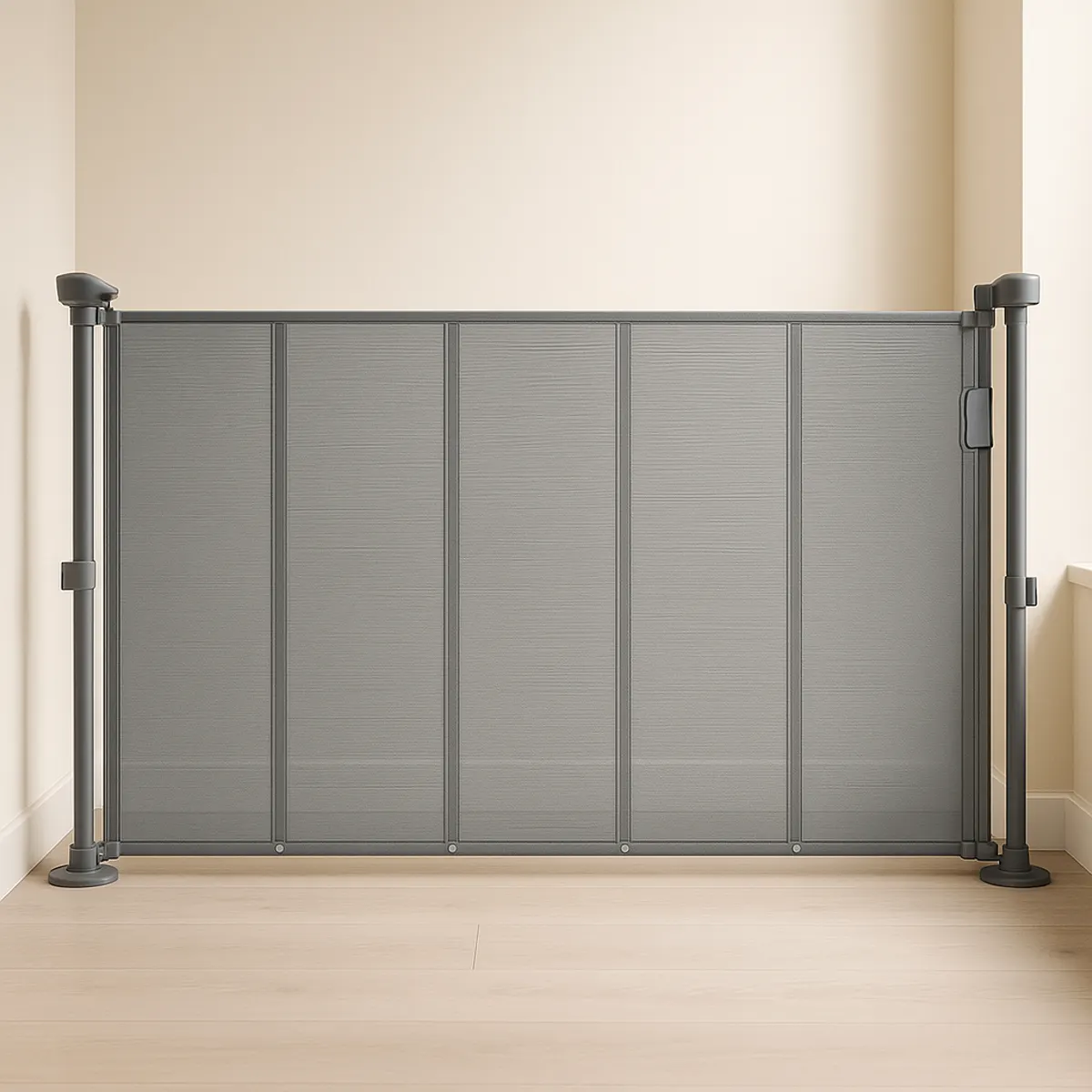
Wood gates: what happens when a dog decides to chew one
Wood is the material people buy with their eyes. A stained slat gate reads as furniture rather than safety equipment, it is rigid, and the weight discourages a dog from shoving it aside. Real advantages, worth saying first.
The drawback is that wood is the only one of the three a dog can remove material from. A bored dog chewing a slat takes something off every session, and once the finish breaks the bare wood absorbs saliva, swells, and softens at the spot already damaged. Hardwood slows that cycle. It does not stop it.
Weight cuts both ways. A heavy gate resists a push, but that load goes into hinges or pads pressed against drywall, and a gate heavy enough to stop a large dog is heavy enough to work its own mounting loose. Wood suits a calm, older dog that has never tested a barrier.
Metal gates: the material holds, the bars are the opening
Powder coated steel and aluminum are the toughest surfaces here. A dog is not chewing through a steel bar, and scratches in powder coat are cosmetic.
Raw strength is not the whole question. Bar spacing is set around a toddler's head, and that spacing is a gift to a dog: a snout fits between two bars, a paw follows, and a dog with a paw through has a lever it can pull with its whole shoulder. The other weak point is the latch, the only moving part and the first to wear. The bar versus panel geometry gets more room in our dog gates for stairs guide.
Mesh gates: everything depends on whether the panel is reinforced
It is the only one of the three where the weak point is invisible on day one. Mesh works by tension: pulled flat between two anchors, it leaves no slack to push into. Let it stretch a few percent and the panel bellies out, lifting the bottom edge off the floor.
SnugGate answers that with 4 fiberglass rods sewn through the panel, running its full height. They hold its shape independently of how hard the poles pull, which keeps the panel flat after weeks of a dog leaning on it. It is also built with a minimal bottom gap by design.
Reviewer feedback here is short and consistent. A reviewer in France wrote: "Hyper solid, we are very satisfied!" One in Portugal put it as "Very good quality. Solid construction." Sagging shows up loudly in reviews when it happens, and it is not what these reviewers described. More on our reviews page.
Match the material to how your dog actually fails a gate
| What your dog does | What it does to the gate | Material that struggles most |
|---|---|---|
| Chews | Takes material off exposed edges | Wood |
| Leans and pushes | Loads the panel center and the mounting | Unreinforced mesh |
| Paws through gaps | Turns a bar into a lever | Bar-style metal |
| Noses at floor level | Pries up at the gap under the frame | Any wide bottom gap |
| Jumps | Clears the top edge entirely | All three, height decides |
The photo above is a Verified reviewer in Spain who set up the 110" size in Black across a garage entrance, with his dog behind the panel. His written feedback was brief: "Everything perfect, easy installation."
Fiberglass rods sewn into each SnugGate mesh panel, which is what keeps the fabric flat
— SnugGate product specifications, 2026
Panel height on all three sizes, the ceiling on what any material does about a jumper
— SnugGate product specifications, 2026
Average rating across 16 Verified reviews, including installs photographed with a dog behind the gate
— SnugGate Verified reviews, 2026
Material or mounting: which one gives out first
The material is what your dog touches. The mounting is what actually holds. A steel gate on pressure pads that loosened over a season gives way well before a properly tensioned mesh panel does.
SnugGate sits on telescoping poles seated on a floor base plate, with an optional floor hook for extra hold. No permanent wall drilling is required, which is why renters land on this style, and the tension takes seconds to check and reset.
One limit applies regardless of material: this is a pressure mounted system, so we do not recommend it at the top of a staircase, where CPSC, Consumer Reports and Safe Kids Worldwide all point to a hardware mounted gate instead. Our baby gate for stairs page covers that setup. As with any gate, always supervise young children and dogs near stairs.
Porches and garages: what weather does to each material
Moisture cycles are what kill wood outdoors: it takes on water, dries, moves, and every cycle opens the grain further where a dog has already chewed. Metal survives that better, with the caveat that powder coat is a coating rather than a property of the steel underneath.
The terrace above is another Verified reviewer in Spain, who installed the 110" size between two stone pillars and sent the photo with no written feedback, so we will describe what it shows rather than invent a quote: the panel spans the opening, with a pet food bowl on the tiles nearby. Check anchor points and tension periodically outdoors, and see the pet gate page for more.
Frequently asked questions
Can a dog chew through a mesh pet gate?
A mesh panel gives a dog very little to bite around, which is why chewers do less damage to it than to a wooden slat. That is not chew-proof: any gate left with an unsupervised, determined dog can be worked on, and the mesh is scratch-resistant rather than indestructible.
Is a metal gate always stronger than a mesh one?
The metal itself is stronger than any fabric, but the gate is more than the metal. Bar spacing gives a dog somewhere to put a paw or a jaw, and the latch and the mounting usually give way first.
Does a wooden gate work outside on a porch?
Untreated or lightly finished wood is the weakest of the three outdoors. Damp swells it, drying shrinks it, and a dog working a spot where the finish already broke speeds that up. Mesh or a coated metal frame handles a porch better.
Which material suits a puppy that chews everything?
Start with the material that offers the fewest edges, which is mesh, and treat the gate as management rather than a fix. A chewing puppy is telling you something about boredom or anxiety that no barrier answers on its own.
For openings wider than a standard doorway, our extra wide gate guide covers measuring and the 110" limit. For how the panel folds away, read retractable dog gates or the retractable baby gate breakdown. Pricing and sizes are on the SnugGate homepage.

Morgan Reyes · Product Safety Reviewer, SnugGate
Morgan checks bar/mesh spacing and structural strength claims against published CPSC standards before a SnugGate size is listed for sale.
Published July 2026. See how we test.
Free worldwide shipping · Delivered in 6-10 business days · 30-day money-back guarantee